

Short answer: on a modern common rail diesel, there is very little injector cleaning you can safely do yourself. You can use a quality diesel fuel additive, keep your fuel clean, and service the fuel filter on schedule. Actual injector cleaning means removing the injectors, cleaning them ultrasonically with the correct solution, flushing them, and then flow-testing them on a calibrated bench. Household chemicals, brushes and compressed air do not clean a common rail injector; they damage it. This guide explains why, and what to do instead.
A common rail injector is not a simple nozzle. Bosch solenoid and piezo common rail injectors operate at roughly 1,800 to 2,500 bar, and they meter fuel through internal passages and spray holes machined to micron-level tolerances. The spray pattern that results is what makes combustion clean and efficient. A scratch, a trace of residue, or a particle left behind inside is enough to ruin that pattern permanently.
This is also why the injector cannot be judged by eye. Even after a visually perfect clean, the only way to know whether it meters and sprays correctly is to test its flow and spray on a calibrated test bench. Without that test, you are guessing.
Use a quality diesel fuel additive. A cleaner designed specifically for diesel fuel systems, added to the tank at the recommended dose, can dissolve light deposits and help maintain spray quality as you drive. This is preventive maintenance, not a repair. It will not restore an injector that is already worn, leaking or badly fouled.
Keep your fuel clean. Most injector fouling and wear starts with the fuel. Buy from reputable sources and be careful with fuel stored in private tanks, drums or jerry cans, which can pick up water, rust or chemical contamination. This matters most for agricultural and off-highway machines refuelled from on-site storage.
Service the fuel filter on schedule, and inspect it. The filter is your early-warning system: metal particles or heavy debris in the filter tell you something upstream is failing. Have the filter changed properly, because introducing air into the fuel system and then cranking the engine to prime it can damage the high-pressure pump.
Act on symptoms early. Rough idle, hard starting, misfires, loss of power, higher fuel consumption or a strong fuel smell all warrant a diagnostic scan and a fuel system check before the problem spreads.
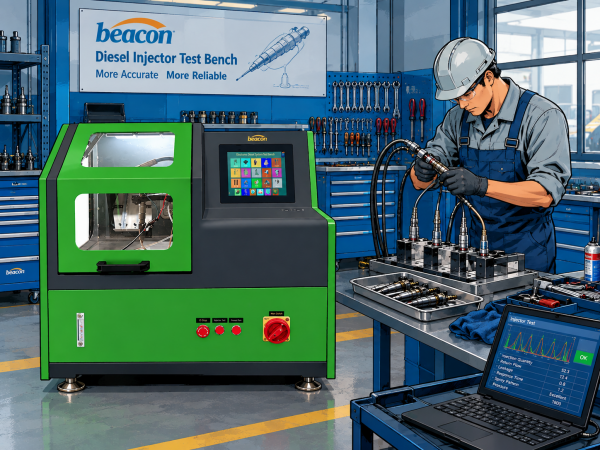
Before deciding whether a common rail diesel injector needs cleaning, recalibration or replacement, test it first. The EPS208S common rail injector test bench is designed to help diesel technicians and injection specialists identify injector performance problems before carrying out unnecessary cleaning or replacement.
A common rail injector may appear clean externally and still have excessive return flow, incorrect fuel delivery, poor spray performance or other internal problems. The EPS208S allows technicians to test key injector parameters under controlled conditions, providing measurable data that can be compared with the manufacturer's specifications.
The EPS208S supports a wide range of common rail injectors, including injectors from Bosch, Denso, Delphi and Siemens, making it suitable for diesel repair shops, injector specialists and workshops servicing passenger cars, commercial vehicles, agricultural machinery and other diesel equipment.
Depending on the configuration, the test bench can be used for functions such as fuel delivery testing, return-flow measurement, injector performance testing, injector coding and common rail system diagnosis. Optional functions can also include BIP testing, Bosch four-pin injector testing, rail pressure sensor testing, DRV/HPV testing and solenoid valve testing.
The purpose of testing is not simply to confirm that an injector is "dirty." It helps determine why the injector is not performing correctly. If the test results indicate contamination and the injector remains within serviceable limits, professional cleaning may be appropriate. If the results indicate excessive wear, leakage, electrical failure or other damage, replacement or professional injector repair may be required instead.
This is why testing should come before cleaning. The EPS208S provides a practical diagnostic step that helps technicians avoid unnecessary cleaning, identify faulty injectors and make more reliable decisions about cleaning, recalibration or replacement.
Test first. Clean when appropriate. Replace when necessary. That approach is safer than trying to clean a common rail injector based only on symptoms or visual inspection.
Household cleaning solutions. Vinegar, lemon juice, baking soda and similar mixtures are sometimes suggested online. Acidic solutions corrode precision surfaces and attack seals and O-rings; abrasives such as baking soda leave residue and score the very surfaces that must stay perfect. Neither belongs anywhere near a common rail injector.
Carburettor cleaner and other aggressive solvents. These are formulated for petrol systems. On a diesel injector they can attack seals and internal components, and they strip the protective diesel film that lubricates the precision parts, which increases wear rather than reducing it.
Wire brushes, picks and compressed air on the nozzle. The spray holes and the needle seat are machined to microns. Any mechanical contact scratches them, and the damage to the spray pattern is permanent. Blowing air through the injector can also drive loose particles further inside.
Do-it-yourself flush kits connected to the high-pressure side. Common rail systems hold extreme pressure. Improvised flushing is a safety risk and it cannot verify whether the injector works afterwards.
Ultrasonic cleaning without a flow test. Ultrasonic cleaning is a legitimate part of the professional process, but on its own it is incomplete. It dislodges deposits that then need to be flushed out; if they stay inside, they re-enter the fuel system when the engine runs. And without a bench test afterwards you have no way to confirm the injector meters correctly.
Done properly, the injectors are removed and inspected, cleaned in an ultrasonic bath with a solution formulated for fuel injection components, thoroughly flushed so that no loosened particle remains, and then flow- and spray-tested on a calibrated bench against the manufacturer's values. Seals and O-rings are renewed. On refitting, the injector's calibration code is programmed into the ECU, because a modern engine needs that value to fuel correctly.
That final test is the whole point. It is what separates a cleaned injector from an injector that merely looks clean.
Cleaning restores a fouled injector. It cannot restore a worn or damaged one. If the nozzle or needle seat is worn, if the injector leaks, if there is an electrical fault in the solenoid or wiring, or if debris from a failed high-pressure pump has already passed through the system, the injector should be replaced rather than cleaned. Many piezo injectors are not serviceable at all and are supplied and replaced as complete units.
The same logic applies right across the range, from passenger cars and vans to trucks, tractors, combine harvesters, excavators and other off-highway machinery, marine engines and generator sets. For workshops dealing with common rail injector cleaning and repair, the first step should always be accurate testing—not guessing.
 English
 Русский
 Español