

Beacon Company Technology Department
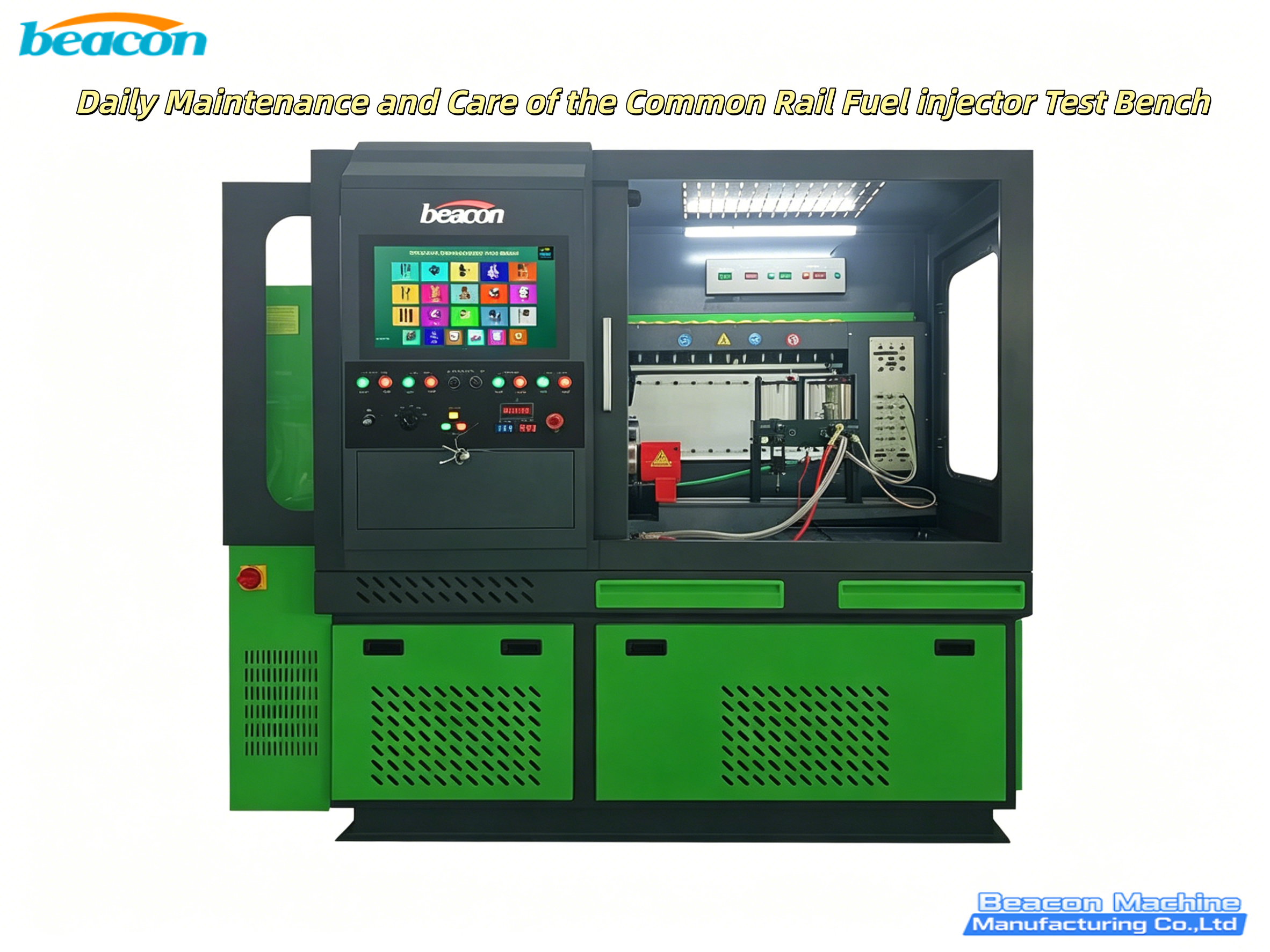
As a precision testing instrument, the common rail injector test bench requires extremely stringent maintenance for its core components (high-pressure pump, pressure sensor, and precision oil circuit). Routine meticulous maintenance not only extends the equipment's service life but also ensures accurate and stable test data while reducing failure rates. The following outlines the standard daily maintenance procedures for the equipment:
I. Daily Maintenance: Always perform inspection upon startup with thorough attention to details
1. Oil Inspection:
Before daily startup, check the pump oil level (recommended to meet JB-1/ISO4113 standards) and maintain it at 3/4 full of the tank; replenish promptly if insufficient. Assess the oil cleanliness; replace the oil immediately if turbidity or impurities are observed.
2. Filter System Cleaning:
Inspect the oil circuit filter and its filter element. If blockages or contamination are detected, clean or replace them promptly to prevent impurities from entering the precision oil circuit and causing wear or clogging.
3. Electrical Connection Inspection:
Check whether the power lines, sensor cables, and communication interfaces are securely connected, free from damage, aging, or loosening, to prevent measurement errors or equipment failures caused by poor contact.
4. Surface Cleaning:
Wipe away oil and dust from the equipment surface, with particular attention to cleaning precision components such as fuel injector mounting brackets and test connectors, ensuring they are free of impurities and oil stains to maintain testing seal integrity and accuracy.
II. Weekly Maintenance: Thorough Cleaning and Functional Verification
1. Thorough cleaning of the oil circuit system:
Clean the interior of the oil tank and remove sedimentary impurities from the bottom; inspect and clean the high-pressure oil circuit interfaces to ensure they are free from oil contamination and impurities, thereby preventing interference with pressure stability.
2. Pressure system calibration:
Initiate the equipment for no-load pressure testing to verify the consistency between the pressure gauge and pressure sensor readings, ensuring that the pressure control accuracy remains within the ±0.5 MPa range; if the deviation exceeds the specified limit, perform immediate calibration.
3. Lubrication of moving parts:
Apply lubricant to moving components such as equipment rails, couplings, and universal joints, inspect for wear conditions, and make timely adjustments or replacements if loosening or abnormal wear is detected.
III. Monthly Maintenance: Comprehensive Inspection and Hazard Identification
1. High-pressure component inspection:
Conduct a comprehensive examination of high-pressure components such as high-pressure pumps, high-pressure hoses, and injector connectors to check for leaks, cracks, or signs of aging; the use of swollen or damaged high-pressure hoses is strictly prohibited, and any identified issues must be replaced immediately.
2. Electrical System Inspection:
Check the internal wiring, contactors, and relays of the electrical control cabinet for signs of overheating, aging, or loosening; test the grounding reliability to ensure that the ground resistance is ≤4Ω, thereby mitigating the risk of leakage current.
3. Software and Parameter Backup:
Check the operational status of the device control software, and regularly back up test parameters and data; promptly upgrade the software upon availability to optimize device performance and compatibility.
IV. Long-term Maintenance: Regular Calibration and Professional Maintenance
1. Annual Professional Calibration:
An independent professional institution is commissioned annually to conduct comprehensive calibration of the equipment, including pressure sensors, flow sensors, and time control accuracy, ensuring compliance with industry testing standards.
2. Seasonal Maintenance:
During seasonal transitions, adjust the viscosity of pump oil according to ambient temperature, inspect the temperature control system (normal operating temperature: 40°C ±2°C), ensure stable temperature, and prevent increased viscosity at low temperatures or oil degradation at high temperatures that may affect testing.
Professional supply of common rail injector test benches, ensuring reliable quality and supporting customization!
Those interested can contact directly via WhatsApp: +8618253885135
 English
 Русский
 Español